Search This Blog

Radio Guy Tees

Radio Guy Tees
Radio Guy T-Shirts
Showing posts with label es'hail-2. Show all posts

Tuesday, 13 August 2019

Up-converting - you what?

Well,

Further to the PA I made last time, today I have been finishing off the up-converter to accompany it.

The theory goes something like this:


  • The Portsdown will output DATV on 439 MHz through the transverter output
  • This will be sent down the garden in Ecoflex-15
  • The co-ax losses will be compensated for using the 70cm amp I made back here
  • This will feed the SG Labs transverter we played with back here
  • The output of the transverter is then boosted by the Wi-Fi amp from here 
  • Finally the output is fed to the PA
Here's the up-converter in its finished form, there's a simple sequencer in there to handle the PTT switching and send a PTT signal to the PA:


Tomorrow I hope to install this and the PA in the small shed I have near the dish - then for some on-air testing.

This is the output of the up-converter DVB-S, SR250, FEC 1/2 - received with an antenna across the bench:


** UPDATE**

I've not yet installed the equipment in the garden, so I have about 4-5dB minimum of cable loss between the PA and the dish feed. However, here's my first RX of my own TV signal through Es-Hail'2:


** UPDATE 2 **

I've moved the gubbins to the small shed near the dish:


And am now sending 439MHz (ish) down the garden from the Portsdown.

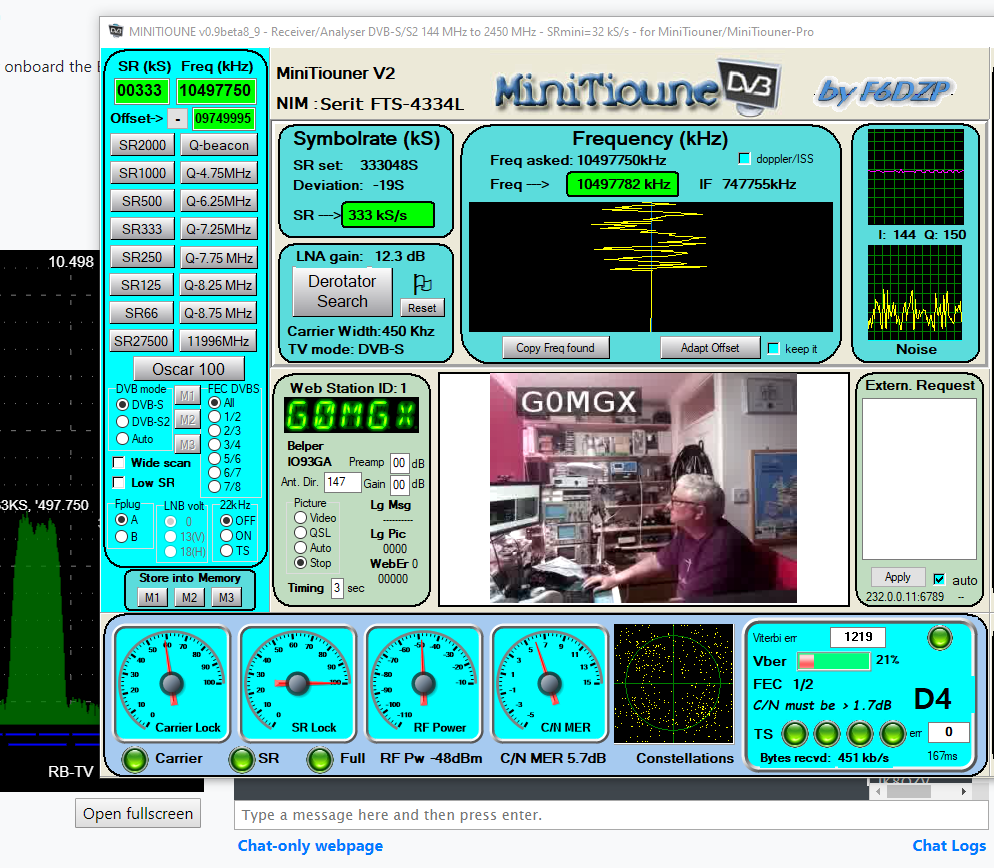
This is a 333KS transmission via QO-100, you can see my signal on the left of the Mini Tioune software at 10,497.750 MHz:

And here is a testcard:


Local conditions.

Sunday, 11 August 2019

Even More Power!

Well,

I've been messing about and finishing off my 13cm linear. The idea is to make something that will work on the 2.3GHz amateur band frequencies as well as 2.4GHz for DATV on Es'hail-2.

This has been quite a challenge, but eventually we have something working ready for on air testing.

This is the final build, which even though I say so myself, is a masterpiece:


The PA module itself is something from my travels made by PowerWave:


There are five MOSFETS in total - each one is a SRF7068H5HS.

This is controlled by a W6PQL Amplifier Control Board which in turn uses an external FET switch to turn on and off the 12V bias lines to the PA, provide the sequencing necessary, generate an ALC voltage (just in case I need it later), generate an external PTT out for switching VLNAs or other external gubbins.

There's also a chassis mounted directional coupler (a NARDA model 31152) which provides a -30dB forward and reflected port output which is attenuated and rectified to produce a DC voltage. There's a forward voltage for a future power meter and also a reflected power voltage to activate a trip if the SWR should exceed 2:1.


I've even included a thermistor on the main heatsync and a trip in the amp control to switch on the fans or even shutdown the amp when over temperature.

I'm seeing about 26dB of gain from the amplifier and it will generate about 250W of CW on 2.407 GHz so should easily generate the 30-40W I might need for some DATV experiments.

Here is the unit under test, I'm using the Portsdown to generate a signal at 432.75 MHz, then using the mixer from the UK Microwave Group forum to mix in 1975 MHz to generate an output on 2004.75 MHz. This is then amplified up and fed to the linear. The forward port of the directional coupler (-30dB) is coupled via another 20dB attenuator to my XL Microwave meter. A short piece of coathanger shoved into the front of the Spectrum Analyser allows me to measure the harmonics and also look at the TX waveform.


A thing of beauty is a joy to behold! I'm delighted with this.

Saturday, 20 April 2019

A Portsdown Conundrum

Well,

As part of my Es'hail-2 experiments, I am now preparing a DATV TX system for the satellite. I've ordered a Spectrian linear amplifier which seems to be the way to go, it looks like this but isnt here yet:


But in the mean time, I have been playing with an eBay sourced "wi-fi booster":


I have modified this to be permanently in TX by shorting pins of the op-amp as per many published explanations:


and simply connected this between the 23cm output port on the Portsdown and the Wi-Fi antenna that came with the amplifier.

Firstly, to test all is well with the setup, I have set the Portsdown to:


  • Frequency 146.5MHz
  • Modulation: DVB-S
  • Encoder: MPEG-2
  • Output to: Lime Mini
  • Source: TestCard
  • SR 1000
  • FEC 7/8
  • Lime Gain 88
This feeds from the 2M output port of the Portsdown to the linear I made back here and then to the 2M beam on the mast.

I have connected a "white stick" antenna thats on the house somewhere to the input of the MiniTiouner from here and these are the results:

Perfection!

Now, I change the Portsdown TX frequency to be 2407.75 MHz, change the antenna on the MiniTiouner to be a 2.4GHz patch on the bench:


and this is the result:

With a suitable piece of wire shoved into the front input socket on the spectrum analyser I can see the 2.4GHz signal I am transmitting:


So I am really not sure why I can't decode the TV signal on the MiniTiouner - any ideas anyone?


** UPDATE **

So, thanks to the BATC forum and mainly G8GKQ, we concluded this was a phase noise issue.

I did some experiments starting at 23cm (1296 MHz) and slowly increased the TX frequency until it failed; I found this to be at 2150 MHz. It turns out the problem is ripple in the PSU for the MiniTiouner - so this is an RX issue not a TX issue as I suspected.

The MiniTiouner includes a buck converter to take the DC input and drop it down to 4V to feed the on-board regulators. I was feeding this with either 12V or 18V and also routing this input voltage up the coax to the LNB. It seems that the higher the voltage, the more the ripple.

I've modified my MiniTiouner now to run the internal RX electronics from the USB power (I have it connected to a USB 3.0 PCI card with an internal PSU connection)  and only now use the external switchable 12/18V for the LNB power.

Not sure I fully understand the reason for the problem, but it is now fixed.

Local conditions.


Monday, 1 April 2019

Digital TV - really? QO-100 again!

Well,

Over the weekend I have been playing with the software KG-STV.

This is a kind of digital TV; its slow scan TV that's digitised on TX.

It took me a while to get the software to key the radio - eventually I figured out it doesnt seem to work if the selected COM port is > 9. Hey ho, as my PC Is COM port city, I had to shuffle some stuff about.

Here's two instances of the software running at the same time; the top one is my TX signal going up on 13cm and the bottom is my RX of the signal on 3cm.


And here is the same image as received by CT1BYM, Miguel:


and here some more images Migual has been kind enough to share. This is his RX setup:


How cool is that?

 Radio Guy T-Shirts

Friday, 22 March 2019

SSTV - though a Satellite?

Well,

Been playing some more with my Es'Hail-2 setup.

I noticed yesterday some SSTV signals on the band from Mauritius; I've not used SSTV before so I installed MMSSTV and have since had some QSOs.


I've annotated some images and created some templates in the software to enable reports and the like to be exchanged:


It's really quite fun!

 Radio Guy T-Shirts

Sunday, 10 March 2019

es'hail-2 dish feed

Well,

Very much inspired by the fun back here, I figured it would be great to try and make a better single feed for the dish for both bands.

This seemed to be just the ticket.

Not this needs to be plumbing, not electronics!

I paid a visit to fellow ham and insane constructor Ian, G4EVK; who has some amazing model making equipment and a good plumbers blowtorch!

Here's some photos of the build:


I'm waiting for a "rocket" LNB that I hope will fit on the end of the waveguide (read 22mm pipe) using a compression fitting, I have also used the trick from here to check the 2.4GHz return loss - after a little bit of bending it's now looking spot on.

Yesterday I very nearly mowed the lawns, today we woke up to this:


Let it snow.....

 Radio Guy T-Shirts


** UPDATE **

I have used the lens from a "rocket" LNB on the front of the feed and removed the feedhorn from an Octagon LNB (with a hacksaw) and connected it all together with a 22mm compression pipe connector and some waterproofing with some silicone. I have also modified the LNB to take an external 25MHz signal (as above):


I've used the same trick I used back here to measure the return loss on 2.4 GHz and its around 20dB; I have also lashed up the receiver on the 10GHz downlink and that is working just fine.

Now, how on earth can I weather proof this?

Miss Maggie and Miss Pepper Cat seem to be economising by using the same bed? Bonkers.


Local conditions....

 Radio Guy T-Shirts

Sunday, 17 February 2019

Es'hail-2 - really?

Well,

I've just lashed together a first attempt at receiving the downlink from Es'hail-2.

If you have been asleep, the is the first ever Geostationary Amateur Satellite and is a bit fab 'n' groovy!

I'm just using an Amazon sourced LNB:


I've stuck it on a dish I had lying in the hedge and attached it to an Azimuth and Elevation rotatormabob - you may remember that setup from here.

There's an LVB tracker with computer driven elevation and azimuth control.

I pointed the dish in very roughly the right part of the sky and then tuned around where I expected the signals to be, with the narrow band transponder downlink at 10489.550 - 10489.800. I've subtracted the 9750 local oscillator in the LNB.

I then found some signals and used the rotator controller to peak the signals - I've ended up at 149 degrees to the south and 18 degrees elevation - there will be many, many errors in my setup at thus time.

I'm a bit off frequency, and also drifting a touch. I need to add external frequency lock to the LNB. I've also started to setup an uplink based on the system we made here.

But I've certainly found it:


So the low beacon on the narrow band transponder is sending:

5i 5i 5i de qo-100 BK dl50amsat

and I am receiving this at a constantly drifting down frequency, currently at:

739.306 MHz on my SDR. So I add the 9750 MHz Local Oscillator and we get 10489.306 MHz

If should be between 10489.550 and 10489.555 MHz so I am a bit out of bonk and drifting.

Next job - lock the LNB to a frequency reference!

Much more to follow on this topic!

 Radio Guy T-Shirts


** UPDATE 1 **

I've modified my LNB to take an external 25MHz frequency - so I can feed it with a locked reference.

This has been done in accordance with the instructions here.


I'm feeding the LNB with some cheap co-ax from Amazon and I have replaced one of the "F" connectors with a BNC and attached it to my Leo Bodnar reference which I have set for 25MHz.

According to the instructions (well, read box) from the LNB:

Model: OQSLG Green HQ
Input: 10.70 GHz - 12.75 GHz
LO: 9.75 / 10.6 GHz (10.6 with 22KHz signal on coax)
0.1dB noise ratio
Gain: 60-65dB
Horizontal 18V; Vertical 12V

Now, with the 25MHz external reference, the low end beacon on the Narrow Band segment of the satellite is exactly on frequency:


I'm still worried about LNB skew as switching to horizontal doesn't null out this beacon completely = not even sure if it should, but I am definitely not seeing the DATV beacon yet so more fiddling is required.

 Radio Guy T-Shirts


** UPDATE 2 **

I've fiddled and now can receive the DATV beacon:


This is really quite fantastic!

 Radio Guy T-Shirts