
Well,
I ordered a DG8 pre-amp for 2M from here last week and it duly arrived. I only ordered the "short" kit as I thought I would probably have a lot of the more common bits needed anyhow.
Here's the completed project:

Here's a close up of some of the surface mount gubbins on the other side of the PCB:

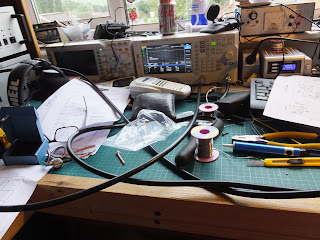
And here's my bench after I had built it - a complete disaster area:
I aligned the pre-amp in accordance with the instructions using a SSB RX but thought the results were quite noisy; I then used the tracking generator and the Spectrum Analyser to align, here's the unit in bypass:

The markers are at 144, 145 and 146 Mhz, here's the aligned version:

I backed the gain off as per the instructions and used my ears to adjust L1, still seems noisy to me.
May have to fiddle some more.the IC-9100 used for my new satellite station can power the pre-amp straight down the coax.
I'm planning to run the amp under the radio bench initially; there's not a very long run of coax to the antenna so I am not sure there is that much to be gained by mast mounting it. Let's see.
Here's Miss Luna Cat, I'm rather hoping she doesn't decide to play "shelf swat" with my Nixie Clock!

Local conditions.
I ordered a DG8 pre-amp for 2M from here last week and it duly arrived. I only ordered the "short" kit as I thought I would probably have a lot of the more common bits needed anyhow.
Here's the completed project:

Here's a close up of some of the surface mount gubbins on the other side of the PCB:

And here's my bench after I had built it - a complete disaster area:

I aligned the pre-amp in accordance with the instructions using a SSB RX but thought the results were quite noisy; I then used the tracking generator and the Spectrum Analyser to align, here's the unit in bypass:

The markers are at 144, 145 and 146 Mhz, here's the aligned version:

I backed the gain off as per the instructions and used my ears to adjust L1, still seems noisy to me.
May have to fiddle some more.the IC-9100 used for my new satellite station can power the pre-amp straight down the coax.
I'm planning to run the amp under the radio bench initially; there's not a very long run of coax to the antenna so I am not sure there is that much to be gained by mast mounting it. Let's see.
Here's Miss Luna Cat, I'm rather hoping she doesn't decide to play "shelf swat" with my Nixie Clock!

Local conditions.


